
REVIEW · USA
Yellowstone National Park Self-Guided Driving Audio Tour
Yellowstone is too big for casual driving. This self-guided audio tour helps turn a long park road into a moving lesson, with more than 140 stories across 150-plus miles. I like the location-triggered narration and the freedom to stop for photos, walks, wildlife, or lunch whenever you please. The main catch is simple: you must download the app and tour before entering the park, since cell service is weak or absent in many areas.
The price is $24.99 per carload of up to four people, which is a strong deal compared with a private guide or bus tour. I also like that access does not expire, so you can split the route across several days or reuse it on a later Yellowstone trip. Just do not mistake the advertised 5 to 6 hours for enough time to see every major corner of this enormous park.
Key points to know before you go
- More than 140 audio stories cover over 150 miles, with routes tied to Yellowstone’s south, west, north, northeast, and east entrances.
- GPS-triggered narration plays automatically, so you can keep your eyes on the road instead of handling your phone.
- Download everything on strong Wi-Fi or cellular service, then use the tour offline inside the park.
- The $24.99 price covers one group of up to four, making it far cheaper than most live guided options.
- You can pause, skip, repeat, and continue over multiple days, a major help in a park where traffic, wildlife, and road work can change your plans.
- Allow more time than the stated 5 to 6 hours if you stop at geyser basins, overlooks, waterfalls, visitor centers, or hiking trails.
How the Yellowstone audio tour works

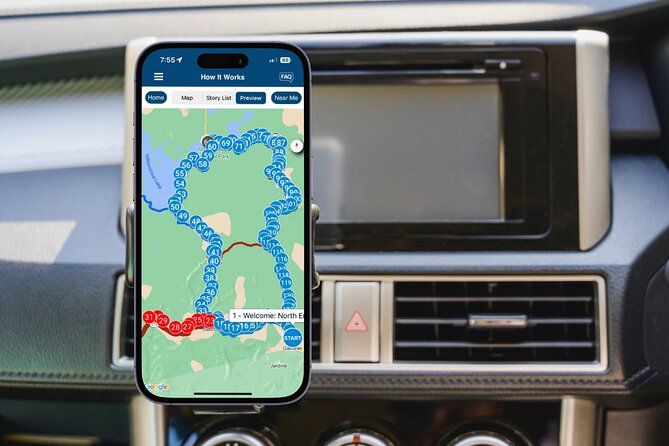
This is not a bus ride, timed group outing, or meeting-point tour. You drive your own car, choose an available starting point and direction, and let the Action Tour Guide app provide directions and narration as you go.
After booking, you receive setup instructions and a password by email and text. Download the separate Action Tour Guide app, enter the password, and download the full tour while you still have a strong connection. Downloading only the app is not enough. The audio files and route need to be stored on your phone before you reach Yellowstone.
Once you arrive at the first story point, the narration begins automatically. GPS triggers the next section as you drive. The system can also help you notice a wrong turn, though it works best when you follow the suggested route and the park speed limit.
You can connect your phone to the car stereo with Bluetooth, USB, or AUX. Apple CarPlay supports audio playback, while navigation features are still being developed. An iPhone with iOS 15 or later, an Android phone with version 9 or later, or a GPS-enabled cellular tablet is recommended.
The most useful feature is the pause button. Stop for a boardwalk, a picnic, a wildlife jam, or a restroom break, then continue when ready. You are not trying to keep up with a guide or a bus full of strangers.
More Yellowstone and Grand Teton Tours in the USA:
- Jackson: Grand Teton National Park Guided Wildlife Tour
★ 4.8 · 676 reviews - Yellowstone National Park – Full-Day Lower Loop Tour from Jackson
★ 5.0 · 502 reviews - From Jackson: Yellowstone National Park Day Trip with Lunch
★ 4.9 · 377 reviews
South Entrance, Grant Village, and West Thumb
If you enter from the south, the tour begins near the South Entrance and leads toward Grant Village. This is a natural approach if you are coming from Grand Teton National Park or lodging near the southern side of Yellowstone.
Grant Visitor Center makes a practical early stop. You can use the restrooms, gather basic park information, and take a break before reaching the Grand Loop. The tour uses this stretch to explain how Yellowstone’s roads connect, which matters because a short-looking route on a map can take much longer once you add traffic and stops.
West Thumb Geyser Basin is one of the first major sights. Its geothermal features sit beside Yellowstone Lake, giving you an unusual combination of hot springs and open water. The audio helps explain what you are seeing, but allow extra time for the walking boardwalk rather than treating this as a quick drive-by.
The route then passes Shoshone Lake, a quieter body of water with access to a hiking trail. Next comes Isa Lake, located on the Continental Divide. These stops are less famous than Old Faithful, but that is part of their appeal. They offer a change from the crowds and geothermal showpieces.
Old Faithful and the Upper Geyser Basin
Old Faithful needs no introduction, but it does reward patience. The geyser is famous because its eruptions are unusually predictable, not because every eruption happens at exactly the same interval. The audio provides context as you approach, while the visitor areas give you room to wait for the next display.
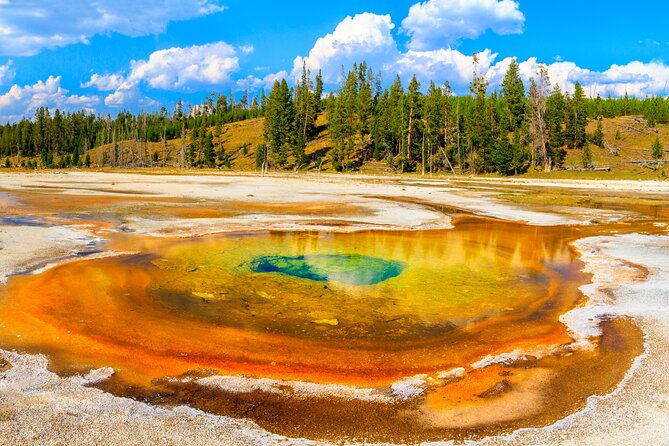
The tour also points you toward Morning Glory Pool. Its blue, yellow, and orange colors are striking, although damage caused by people throwing objects into the spring has affected the feature. Stay on marked paths and treat the basin as a fragile natural system, not a collection of photo props.
Firehole River adds another unusual detail. In places, water warmed by nearby geothermal activity makes the river feel like a natural heated stream. The narration gives this stretch more meaning than you would get by simply driving past a river with a funny name.
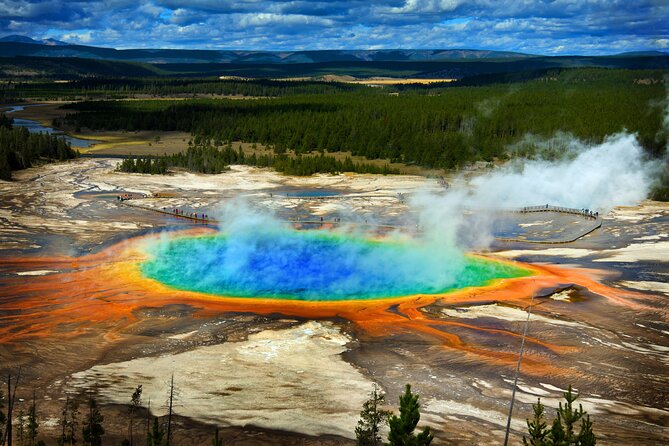
Grand Prismatic Spring is one of the park’s essential stops. You can park and walk close to the spring, then take in the rings of color around its center. The size is difficult to judge from a moving car, so plan on stopping. The audio tour can tell you when the feature is coming, but it cannot solve the parking problem or shorten the walk.
Fountain Paint Pot follows with mud pots that bubble and shift as heat and gases move beneath the surface. This is a good place to hear the difference between a hot spring, geyser, fumarole, and mud pot while seeing several forms of geothermal activity in one short visit.
West Entrance, Gibbon Falls, and Norris
Those entering near West Yellowstone begin at the West Entrance Visitor Information Center. This is a useful place to orient yourself, especially if you are starting late or need to confirm the direction of the loop.
The road then follows the Gibbon River. The narration connects the area to the Shoshone people and the use of local obsidian. That cultural and geological context gives the drive more weight than a string of scenic pullouts.
Gibbon Falls is a practical stop because you can see it from near the road without committing to a long hike. That makes it a good choice if your day already includes several boardwalks. You still get a waterfall view without spending an hour on a trail.
Artists Paintpots offers another boardwalk, this time through colorful mud pots and small geysers. It is easy to underestimate this stop because it is not as famous as Grand Prismatic, but the combination of bubbling mud and little eruptions gives it a character of its own.
Norris Geyser Basin is one of the most important geothermal areas in the park. It is described as the oldest and hottest geyser basin, with temperatures reaching 459 degrees below the surface. That figure is a reminder to respect every railing and boardwalk. The ground is not merely warm, and the crust can be dangerously thin.
One limitation becomes clear on long drives through these sections: the audio does not speak every minute. Some stretches include useful background while you drive, but you may also experience quiet gaps. If you prefer constant commentary, this format may feel sparse. If you like time to talk, watch the scenery, or listen to your own music, the pauses are less of a problem.
More Self-Guided Driving and Audio Tours in the USA:
- Joshua Tree National Park Self-Guided Driving Audio Tour
★ 4.5 · 762 reviews - Ultimate Acadia National Park Self-Guided Driving Audio Tour
★ 4.0 · 521 reviews - From Moab: Half-Day Arches National Park 4×4 Driving Tour
★ 4.8 · 440 reviews - Self-Guided Ebike Tours of Acadia National Park Carriage Roads
★ 5.0 · 427 reviews
Mammoth Hot Springs and the northern approach
The northern route includes Swan Lake Flats, a good area for scanning for wildlife. The tour also explains the connection to one of Yellowstone’s wolf packs, adding a wildlife story without requiring you to find a particular animal.
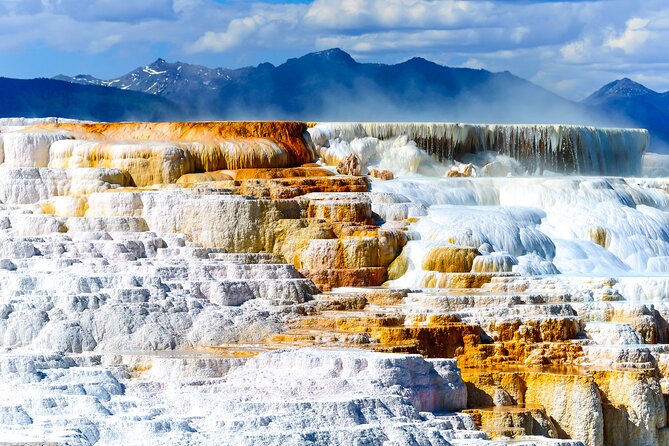
Mammoth Hot Springs is one of the park’s most recognizable features. Mineral-rich water has built pale terraces that look almost architectural. Elk often gather in the area, so keep your distance and do not let an appealing photograph tempt you closer than park rules allow.
From the north entrance, the route passes through Gardiner and the Roosevelt Arch. President Theodore Roosevelt laid the cornerstone in 1903, and the arch marks a historic gateway into the park. It is worth pausing here because the entrance gives you a sense of how Yellowstone was presented to early visitors.
The Albright Visitor Center offers food, restrooms, and a chance to reset. Undine Falls is another roadside waterfall, while Wraith Falls requires a trail from a nearby pullout. These stops show the practical strength of an audio tour: you can decide on the spot which features deserve a walk and which you would rather view quickly.
Tower Junction and Roosevelt Lodge follow. The lodge has a Roosevelt name, but no Roosevelt camped there. That small correction is typical of the tour’s better moments, when it adds a memorable detail to an otherwise ordinary road junction.
Lamar Valley and the northeast entrance
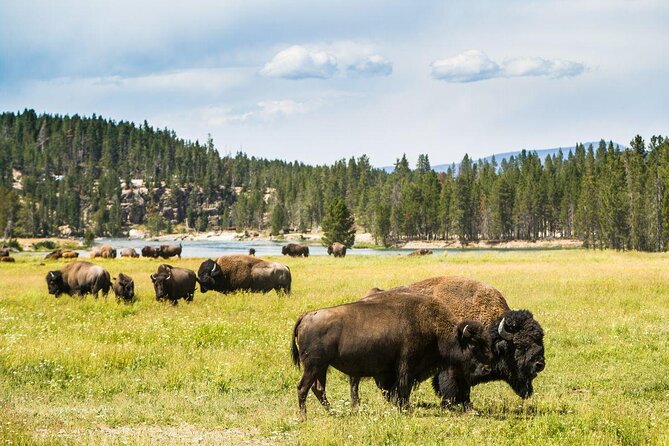
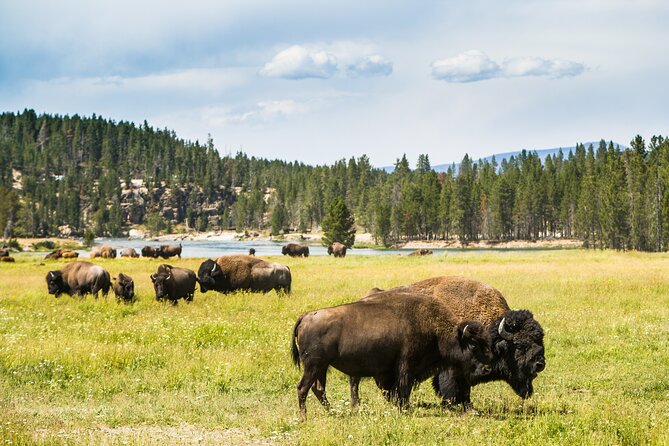
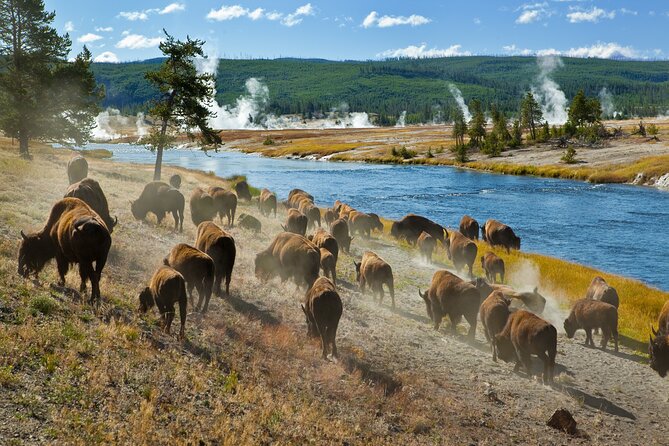
Lamar Valley is the strongest wildlife section of the route. Bison are common enough that you may need to slow down, and wolves are possible but never guaranteed. Bring binoculars, as one useful tip from the tour experience makes clear. Animals may be visible at a distance, and a phone camera will not replace a proper view.
Do not plan Lamar Valley as a quick side trip if wildlife is your main goal. The road itself can be scenic, but animal sightings take patience, and bison traffic can disrupt your schedule. Keep your distance and never stop in a way that blocks the road.
The northeast entrance near Cooke City connects to this section. The tour can start from different entrances, which makes it useful for visitors staying in several gateway towns. When you open the app, choose the version that matches your entrance and driving direction.
Dunraven Pass, Mount Washburn, and the Grand Canyon
Dunraven Pass reaches about 9,000 feet and offers a dramatic change in elevation. The road climbs toward Mount Washburn, whose summit reaches 10,243 feet. The trailhead provides access to an even higher viewpoint, but this is not a casual roadside stroll. Weather and time can change quickly at elevation, so treat it as an optional hike rather than a guaranteed stop.
Canyon Village is a working community for park employees, not a polished resort town. That gives you a brief look at the practical side of running Yellowstone. You can stop for supplies and services, but do not expect a major city center.
The Grand Canyon of the Yellowstone deserves real time. Inspiration Point is one of the best-known overlooks, with a view into the canyon and toward the Yellowstone River. The color and scale are easy to miss if you only glance from a car window, so use the tour’s narration as a prompt to stop and look.
Hayden Valley follows. It is now a broad green valley, but it once lay beneath a lake. The tour’s geological storytelling works especially well here because the current view does not reveal its former shape. Give yourself time to scan the open area for bison and other wildlife.
East Entrance, Fishing Bridge, and Yellowstone Lake
Visitors approaching from Cody use the East Entrance. The route then crosses Fishing Bridge and explains an unfortunate chapter in park management, when invasive trout were introduced in an attempt to increase fishing and public interest.
The final major section reaches Yellowstone Lake, the largest high-elevation lake in North America. The water is too cold for swimming, but it makes a fine place for a picnic or boat ride. After a day of geyser basins and canyon overlooks, the lake offers a broad, quiet finish.
This eastern route also shows why you should not expect to complete every branch in one short outing. Yellowstone covers nearly 3,500 square miles across Wyoming, Montana, and Idaho. The stated 5 to 6 hours works better for a selected route with limited stops than for a relaxed tour of the entire park.
What the $24.99 price really gets you
At $24.99 for up to four people, the cost is roughly $6.25 each in a full car. You also need a Yellowstone entry permit, which is not included, but the audio tour remains inexpensive compared with live private options that can cost hundreds of dollars per person.
The value is strongest for a first visit. You get driving directions, historical background, geology, wildlife notes, and prompts for major stops without paying for a full-day vehicle and guide. You also keep control of the pace.
The audio is not perfect. Some sections have long gaps, and a few people may want more detail about roadside features, rivers, or the sights between major stops. GPS timing can also be imperfect if you take a detour, drive past a point quickly, or approach a stop from an unexpected direction.
That is why I see this as a strong companion, not a complete replacement for park information. Use the official park map, check road conditions, and confirm seasonal closures before you set out.
Best timing, preparation, and who should buy it
Download the tour several days before your visit, then open it at the hotel or another place with dependable service. Test the sound through your car stereo. This avoids the most frustrating problem possible: arriving at Yellowstone and discovering that the files were never downloaded.
Most park roads close to regular vehicles during winter, with limited access until late April. Check current road status before booking a spring, fall, or winter visit. The tour has lifetime access with no expiry, so there is no reason to force a road trip into a closed season.
I would recommend it to first-time visitors, families, couples, and independent drivers who want useful commentary without a fixed schedule. It is also a good fit if you plan to visit over several days and want one low-cost guide for different entrances.
I would hesitate if you want a live guide answering questions, constant commentary, or a tightly timed sightseeing plan. The tour is private and flexible, but that also means you handle parking, route choices, weather, road closures, and time management yourself.
Free cancellation is available up to 24 hours before the scheduled start time. Inside that window, the payment is not refunded.
Should you book the Yellowstone audio tour?
Yes, if you will be driving Yellowstone and can download the tour in advance. The price is modest, the narration adds useful context, and the GPS prompts help you notice stops you might otherwise pass.
Use it with realistic timing. Pick one entrance and one major route for the day, then leave room for geyser eruptions, wildlife jams, walks, and meals. If you treat the audio as a flexible companion rather than a promise to see the entire park in six hours, it is one of the better-value ways to make sense of Yellowstone’s huge road system.
FAQ
How much does the Yellowstone self-guided audio tour cost?
The tour costs $24.99 per group of up to four people. Yellowstone’s park entry permit is separate and is not included.
Does the tour work without cell service?
Yes, but you must download the app and the complete tour while you have strong Wi-Fi or cellular service. Once downloaded, the tour works offline.
How long does the tour take?
The driving audio tour is described as taking about 5 to 6 hours, with some route sections listed at 4 to 6 hours. Allow considerably more time if you stop for walks, photos, wildlife, meals, or visitor centers.
Can I use the tour over more than one day?
Yes. The tour has lifetime access with no expiry, and you can pause it, resume it, and use it across multiple days or future trips.
Which phone or device should I use?
An iPhone with iOS 15 or later, an Android device with version 9 or later, or an iPad or tablet with GPS and cellular connectivity is recommended. You can connect the audio to your car with Bluetooth, USB, or AUX.
Can I cancel for a full refund?
You can cancel for a full refund at least 24 hours before the experience start time. Cancellations or changes made less than 24 hours before the start time are not refunded.
More Audio Tours in the USA
- Arches National Park Self-Guided Driving Audio Tour
★ 4.5 · 288 reviews - Self-Guided GPS Audio E-Bike Tour Hawaii Volcanoes National Park
★ 4.5 · 131 reviews - Canyonlands National Park Self-Guided Driving Audio Tour
★ 4.5 · 54 reviews - Full-Day Audio Driving Tour of Arches National Park
★ 4.5 · 27 reviews
Just added around the USA
- From Flagstaff: Grand Canyon National Park Tour★ 4.9 · 106 reviews
- From Denver: Guided Hike in Rocky Mountain National Park★ 4.2 · 9 reviews
- From Seattle: Full-Day Mt Rainier National Park Tour★ 3.5 · 6 reviews
- From Anchorage: Wilderness, Wildlife, & Glacier Experience★ 4.9 · 85 reviews
- Everglades National Park: Private 2.5-Hour Photo Safari★ 4.9 · 9 reviews
- Everglades National Park: Boat Assisted Kayak Eco Tour★ 4.7 · 25 reviews
- Everglades National Park: Pontoon Boat Tour & Boardwalk★ 4.2 · 44 reviews
- Everglades National Park: Motorboat Eco Tour★ 5.0 · 15 reviews
Yellowstone and Grand Teton Tours, compared.

Jackson: Grand Teton National Park Guided Wildlife Tour
Read our review →
Yellowstone National Park – Full-Day Lower Loop Tour from Jackson
Read our review →
From Jackson: Yellowstone National Park Day Trip with Lunch
Read our review →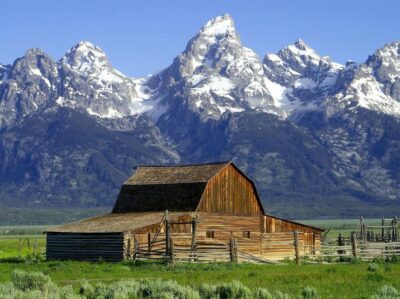
From Jackson: Half-Day Grand Teton National Park Tour
Read our review →
Half-Day Wildlife Safari Tour in Grand Teton National Park
Read our review →
Grand Teton National Park – Sunset Guided Tour from Jackson Hole
Read our review →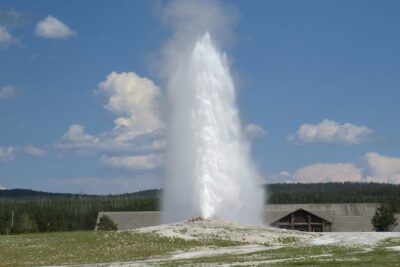
Yellowstone National Park – Full-Day Lower Loop Tour from West Yellowstone
Read our review →
Grand Teton National Park – Full-Day Guided Tour from Jackson Hole
Read our review →Browse the lists this tour appears in